
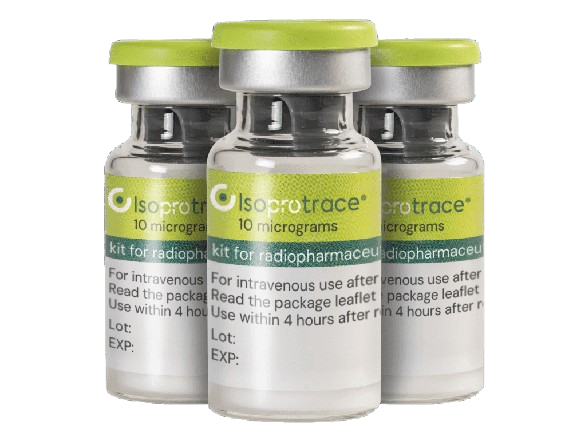

AN ADVANCED PSMA-11 RADIOLABELING KIT FOR PROSTATE CANCER IMAGING
A reliable, efficient, and user friendly solution for Gallium 68 PSMA-11 preparation, supporting high quality prostate cancer diagnostics.
Isoprotrace® has obtained Marketing Authorization (MA) in France, Italy, Poland, Finland, Norway, Portugal, Austria, Belgium, and Luxembourg.
Isoprotrace® is an advanced PSMA-11 radiolabelling kit designed for the preparation of Gallium-68 Gozetotide for PET imaging of prostate cancer. The kit enables a streamlined, efficient, and reproducible workflow, supporting clinicians and radiopharmacies in delivering high-quality PSMA imaging.
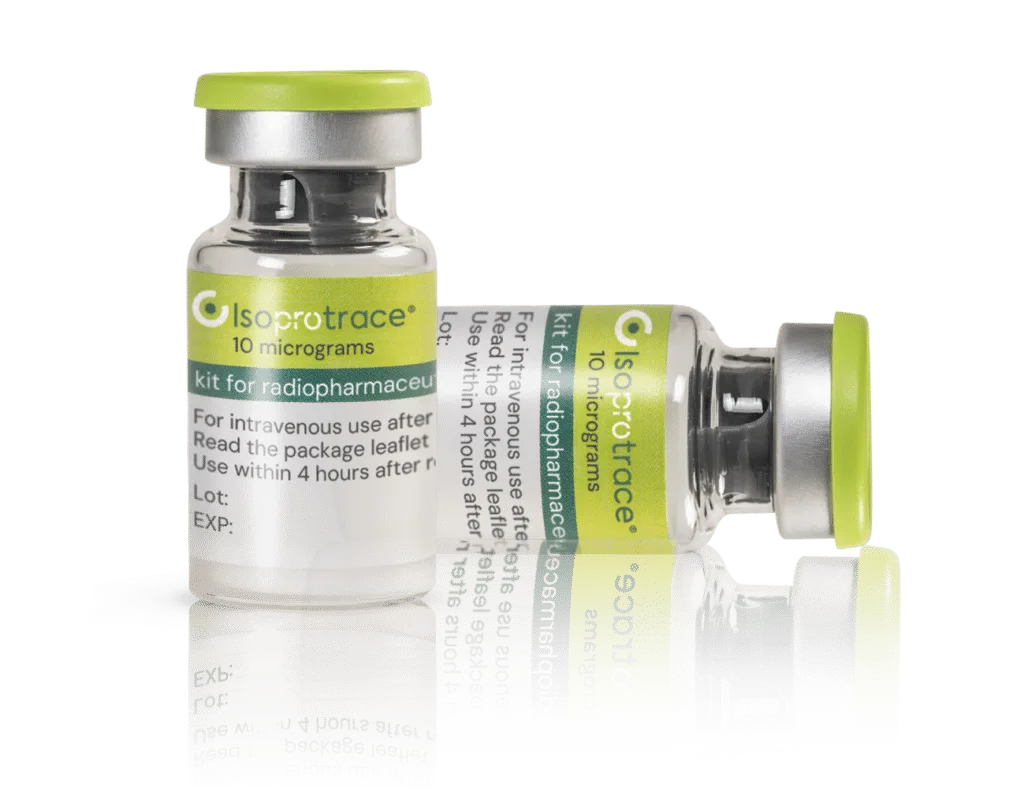
- Active ingredient: 10µg Gozetotide (PSMA-11)
- Presentation: Multi-dose sterile vacuum vial
- The Package contains: 5 vials
- Shelf life: 2 years

Easy Multi-Dose Preparation
Economically attractive, multi-dose preparation performed in just 5 minutes

Time and Resource Efficient
Minimal product loss due to faster preparation time and minimal handling.

Single Sterile Vacuum Vial
Ready-to-use, simplifies the labeling process.

High-Precision PSMA Biomarker
Contains PSMA-11 for precise prostate cancer diagnosis.

Simplified QC
RCP with iTLC; no HPLC needed, fewer tests required.

Quality Assured
Manufactured in FDA-inspected facilities, compliant with EU GMP.
Isoprotrace® is indicated for PET imaging of PSMA-positive lesions in adult men with prostate cancer:
- Primary staging of patients with high-risk prostate cancer prior to primary curative therapy.
- Suspected prostate cancer recurrence based on elevated serum prostate-specific antigen (PSA) level, after primary curative therapy.

What is PSMA?
Prostate-Specific Membrane Antigen (PSMA) is a protein highly expressed in prostate cancer cells, makes it a valuable biomarker for both detecting and targeting prostate cancer.
PSMA PET/CT combines the functional imaging capabilities of PET with the anatomical detail of CT, allowing for precise localization of cancerous lesions.
Importance of PSMA Imaging
- High sensitivity and specificity for detecting prostate cancer lesions.
- Useful in both primary staging and recurrence detection.
- Aids in treatment planning and monitoring.
Advanced Imaging Capabilities
Isoprotrace® leverages cutting-edge PSMA-targeted imaging technology to provide:
- High Sensitivity and Specificity: Detect even small metastases with precision¹-².
- Whole-Body Scanning: Comprehensive assessment of primary tumors and metastatic spread³-⁴.
- Clear Visualization: High-contrast images for accurate interpretation⁵.
- Early Detection: Identify recurrence at lower PSA levels compared to conventional imaging⁶-⁷.
Isoprotrace® offers unparalleled convenience with on-site preparation
Radiolabeling
With Gallium-68 (68Ga)

5-Minute Preparation
Rapid, efficient process from start to finish

Generator Compatibility
Fully compatible with both(68Ge)/(68Ga) generators approved in Europe

Storage
Store in refrigerator (2°C – 8°C), before reconstitution

Quality Control
RCP with iTLC (no HPLC needed), fewer QC tests required
Shelf Life
2 years from the date of manufacture when stored properly

For radiolabelling PSMA‑11 with Gallium‑68 for PET imaging of prostate cancer.
The pH of the prepared Isoprotrace® solution typically ranges from 4 to 5.8.
The kit is designed with a streamlined, step‑by‑step workflow that minimizes handling, reduces preparation time, and supports reproducible Ga‑68 PSMA‑11 radiolabelling for routine clinical use.
Only iTLC (Instant Thin-Layer Chromatography) is required for quality control; HPLC is not necessary.
Yes. The kit is optimized for efficient multi‑dose production to support routine clinical workflows.
Seamlessly compatible with every ⁶⁸Ge/⁶⁸Ga generator approved in Europe.
Once radiolabelled, the Isoprotrace® solution is stable for up to 4 hours at room temperature.
Radiochemical purity with iTLC and pH.
Want To Learn More?
Download the brochure
References
- Ida Sonni, Adam B. Weiner, Sahith Doddipalli, Madhvi Deol, David Ban, Hye Ok Kim, Tristan Grogan, Preeti Ahuja, Nashla Barroso, Yang Zong, Priti Soin, Anthony Sisk, Johannes Czernin, William Hsu, Jeremie Calais, Robert E. Reiter, Steven S. Raman. Clinical, Pathologic, and Imaging Variables Associated with Prostate Cancer Detection by PSMA PET/CT and Multiparametric MRI.Journal of Nuclear Medicine Oct 2024, jnumed.124.268443; DOI: 10.2967/jnumed.124.268443.
- HopeTA, GoodmanJZ, AllenIE, CalaisJ, FendlerWP, CarrollPR.Meta-analysis of 68Ga-PSMA-11 PET accuracy for the detection of prostate cancer validated by histopathology. J Nucl Med. 2019;60(6):786-793. doi:10.2967/ jnumed.118.219501.
- Al Saffar H, Chen DC, Delgado C, Ingvar J, Hofman MS, Lawrentschuk N, Perera M, Murphy DG, Eapen R. The Current Landscape of Prostate-Specific Membrane Antigen (PSMA) Imaging Biomarkers for Aggressive Prostate Cancer. Cancers. 2024; 16(5):939..
- HopeTA, Eiber M, Armstrong WR, etal. Diagnostic accuracy of 68Ga-PSMA-11 PET for pelvicnodal metastasis detection prior to radical prostatectomy and pelvic lymph node dissection: a multicenter prospective phase 3 imaging trial. JAMA Oncol. 2021;7(11):1635-1642. doi:10.1001/jamaoncol.2021.3771.
- Zhou J, Wu R, Wang W, Zhao Y, Liu X. (68)Ga-PSMA PET/CT for the evaluation of metastasis in patients with prostate cancer: a systematic review and meta-analysis. Hell J Nucl Med. (2022) 25(3):297–311. doi: 10.1967/s002449912525.
- Kunst N, Long JB, Westvold S, et al. Long-Term Outcomes of Prostate-Specific Membrane Antigen–PET Imaging of Recurrent Prostate Cancer. JAMA Netw Open. 2024;7(10):e2440591. doi:10.1001/jamanetworkopen.2024.40591.