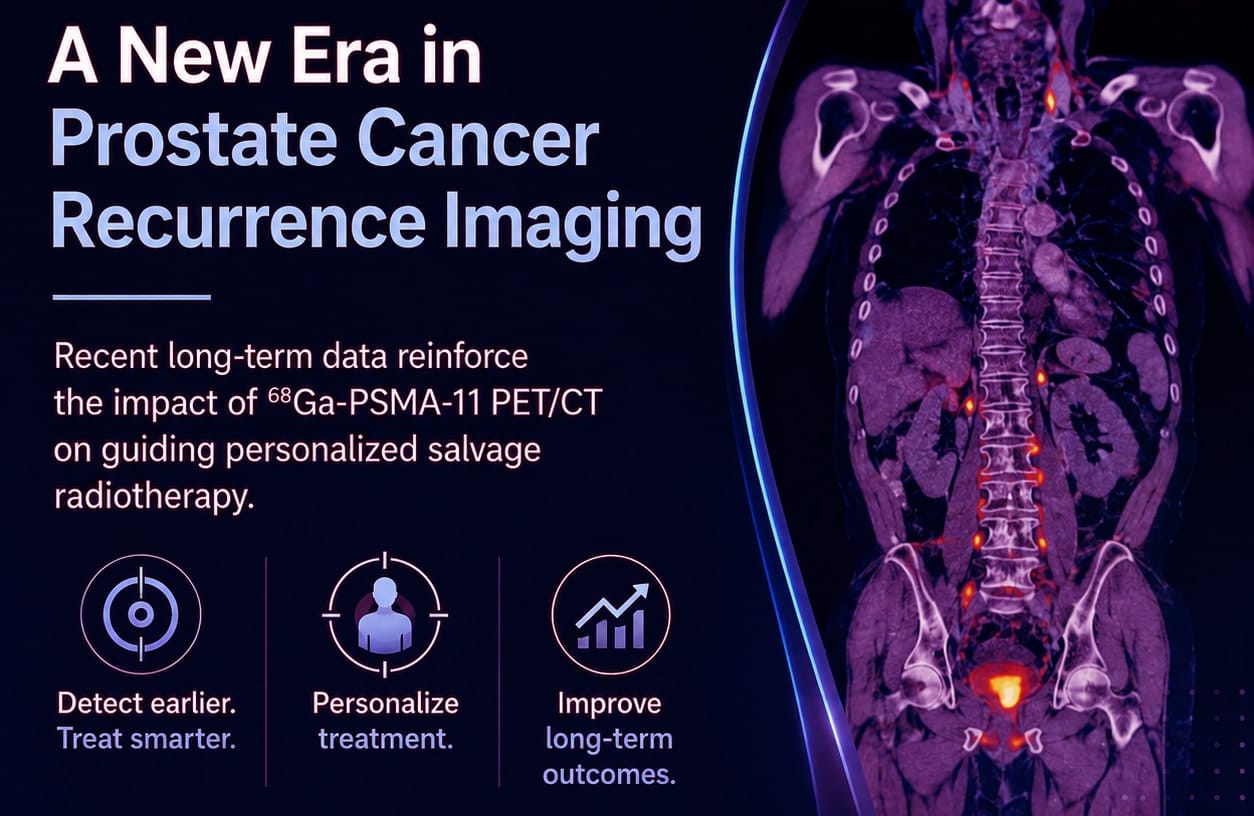
PSMA-11 PET/CT in Prostate Cancer Recurrence: Five-Year Clinical Outcomes and Long-Term Impact
Introduction: A New Era in Imaging for Prostate Cancer Recurrence.
The introduction of 68Ga-PSMA-11 PET/CT has fundamentally shifted our approach to managing prostate cancer recurrence. Unlike conventional imaging, which often leaves clinicians "searching in the dark" at low PSA levels, PSMA-11 acts as a precision beacon.
By targeting the Prostate-Specific Membrane Antigen—a protein overexpressed in nearly all prostate cancer cells—this molecular imaging tool allows us to visualize the exact location of recurrence with unprecedented clarity.
This shift from blind salvage therapy to evidence-based, targeted intervention is not just a technological upgrade, it is a clinical revolution that is directly translating into better long-term survival for our patients.
Following this clinical revolution, a landmark analysis recently published in
JNCCN (Nikitas et al., 2026) has provided the long-term evidence needed to confirm the real-world impact of this technology on patient survival.
This article details a retrospective analysis of five prospective studies evaluating the long-term clinical outcomes of patients who underwent
68Ga-PSMA-11 PET/CT-guided salvage radiotherapy (sRT) following biochemical recurrence after a radical prostatectomy.
Key results include:
- Median progression-free survival (PFS): 49.2 months
- Five-year overall survival rate: 97.1%
Summary of Key Findings
Study Population
The analysis included 113 patients with a median PSA of 0.4 ng/mL at the time of the PET scan.
Detection Rates
- PSMA-11 PET/CT identified visible disease in 59.3% of patients, despite low PSA levels.
Detected recurrence sites included:
- 6% recurrence in the prostate bed
- 5% pelvic lymph node metastasis
- 2% distant metastasis (M1)
Treatment Impact:
PET findings led to more tailored radiation plans, including whole-pelvis radiotherapy (WPRT) for 55.8% of the cohort and metastasis-directed therapy for 87.5% of M1 patients.
Oncologic Outcomes:
The median freedom from distant progression was 76.4 months.
- WPRT was significantly associated with improved PFS in patients with disease limited to the prostate bed (TrN0M0).
- Androgen deprivation therapy (ADT) significantly improved PFS for patients with nodal (N1) or distant (M1) disease.
Clinical Advantages of PSMA-11 PET/CT in Prostate Cancer Recurrence
- Superior Sensitivity at Low PSA: Conventional imaging (CT, MRI, bone scans) typically lacks the sensitivity to detect recurrence when PSA levels are below 1 ng/mL. PSMA-11 PET/CT effectively bridges this gap, enabling the identification of targets at much lower biochemical thresholds.
- Redefining Target Volumes: The high specificity of PSMA-11 allows clinicians to guide salvage radiotherapy more accurately, often extending treatment beyond standard consensus target volumes to encompass PSMA-avid disease that would otherwise be missed.
- Enabling Dose Escalation: Identifying specific sites of recurrence through PSMA-11 PET/CT permits the delivery of boosted radiation doses directly to visible lesions, potentially improving local control.
- Informing Therapy Intensification: The detection of nodal or distant disease via PSMA-11 provides a clear rationale for intensifying hormone therapy (ADT) or implementing metastasis-directed therapy in cases previously thought to be localized.
- Real-World Prognostic Value: The study highlights that even when PSMA-avid disease is detected, outcomes remain favorable with PET-guided sRT, reinforcing the tracer's utility as a standard-of-care tool for restaging at the first sign of biochemical recurrence.
Conclusion: PSMA-11 PET/CT as a Roadmap for Personalized Salvage Therapy
As nuclear medicine continues to evolve, these five-year outcomes confirm that
PSMA-11 PET/CT is not only a diagnostic imaging tool but also a critical roadmap for personalized salvage therapy.
By enabling earlier detection, more precise treatment targeting, and improved therapeutic decision-making, PSMA-guided imaging is helping shape the future of
precision medicine in prostate cancer care.
References
- Nikitas J, Smith CP, Armstrong WR, et al. Five-Year Outcomes After Prostate-Specific Membrane Antigen PET/CT-Guided Salvage Radiotherapy Following Radical Prostatectomy. J Natl Compr Canc Netw. 2026;24(2):11-18 . doi:10.6004/jnccn.2025.7102.